How to Believe in Yourself Again After Failure: 7 Grounded Steps

To believe in yourself again after failure, build evidence rather than affirmations. Small repeatable actions that you can point to afterwards rebuild self-worth in a way that telling yourself you are enough does not.
A setback can shake your sense of what you are capable of, and that is a reasonable reaction rather than a weakness. Growth does not mean guaranteeing outcomes or pretending the obstacle was not real.
I write this from lived experience and my own personal-growth and spiritual beliefs, not from clinical training. Our editorial policy and press pages explain how that line is held.
Why Does Failure Erode Self-Belief?
When a project collapses or a goal slips away, the mind tends to read that as a verdict on you rather than on the attempt. The line between a specific setback and your whole identity blurs quickly, and it blurs in one direction. Naming that leap is the first useful thing you can do, because a failure is a data point and an identity is not.
Rejection also produces a very sensible-feeling withdrawal. After enough setbacks, people stop attempting things, which does protect them from further disappointment and also removes the only supply of evidence that would rebuild confidence. That is the trap. Breaking it means letting the failure hurt without letting it choose what you try next.
It does not help that productivity gets treated as a measure of human value, or that you are comparing your unedited process to everyone else's finished output. Almost nobody posts the eighteen months of trial and error. Defining what success means on your own terms is less a nice sentiment than a practical necessity, because otherwise you are measuring yourself against a number that was never real.
What is the Difference Between Self-Esteem, Confidence, and Self-Efficacy?
These three get used interchangeably and they are not the same thing. Self-esteem is your overall evaluation of your own worth. Confidence is a general trust in your abilities and judgement. Self-efficacy, as the APA Dictionary of Psychology defines it, is your belief in your capacity to carry out the behaviours needed to achieve a specific result. That last one is the useful one after a failure, because it is domain-specific and it responds to practice.
Self-belief is worth having and it does not substitute for skills, opportunities, or a safe situation. Plenty of motivational material implies that believing hard enough opens any door.
It does not. Belief has to be paired with competence and with circumstances that allow the thing to happen. You can have entirely justified confidence in your writing and still need to learn the craft, pitch editors, and absorb a year of rejections before anything gets published. Holding both facts at once is what keeps the work sustainable.
There is a real cost to overstating mindset: when it does not work, you blame yourself for something that was structural. Self-efficacy is domain-specific, so feeling capable in one area tells you very little about another. Understanding that protects you from both toxic positivity and the assumption that you should feel fearless. Confidence gets built from acquired competence, not summoned by willpower, and that is genuinely good news — it means it is available to you.
How to Rebuild Self-Worth: 7 Grounded Steps
These seven steps move the focus from worrying to doing, in an order that builds on itself.

1. Gather Objective Evidence: Write down things you have actually done and hard situations you actually got through. Vague self-doubt loses to specific facts.
2. Clarify Core Values: Work out what matters to you independently of what would look impressive, so your effort goes somewhere you actually want to arrive.
3. Examine Your Internal Narrative: Catch the punitive commentary and swap it for something accurate. Not flattering, accurate.
4. Establish Protective Boundaries: Limit your exposure to the people and environments that reliably leave you smaller than they found you.
5. Focus on Skill Development: Confidence follows competence rather than preceding it. Pick the specific skill the goal requires and work on that.
6. Take Small, Repeatable Actions: Break it down until the next step is small enough to be boring. Boring is repeatable, and repeatable is what generates evidence.
7. Reflect and Adapt: Review what is working at intervals you decide in advance. A misstep is feedback about the method, not a report on your character.
This asks for patience and a tolerance for feeling clumsy while you test new behaviour. Progress will not be linear and you will have weeks that look like going backwards.
Treating each step as an experiment rather than a test lowers the stakes considerably. An experiment that fails still returns information; a test that fails just returns a grade. Over months, those small adjustments are what the change is actually made of.
How Can the Inner Power Canvas Guide Your Daily Practice?
The Self Help Show Inner Power Canvas puts the seven steps on one page with prompts for each: evidence, values, internal voice, boundaries, skills, action, reflection. Filling it in turns the ideas above into something you can look at on a day when you cannot remember any of them.
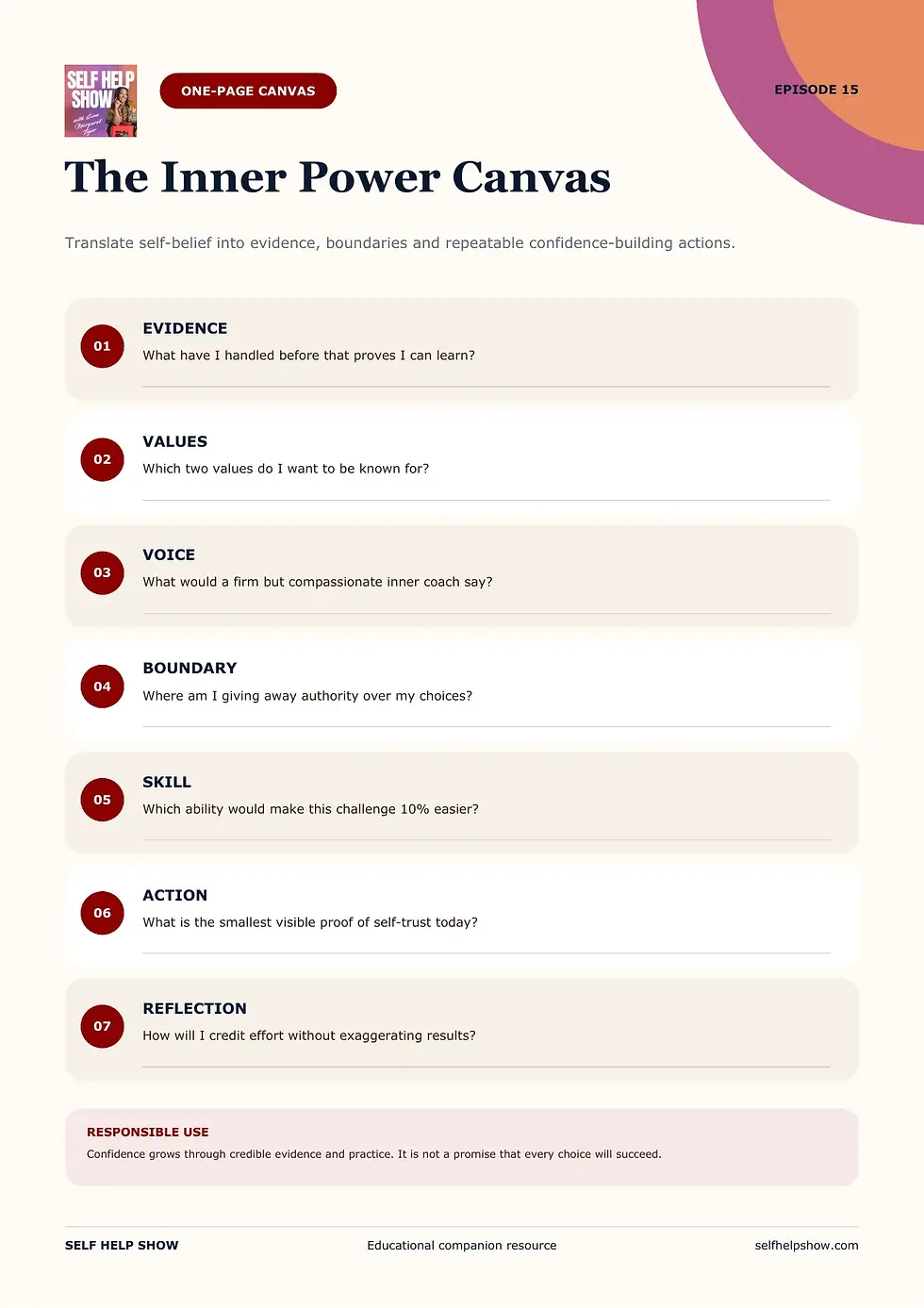
Download the free, printable Inner Power Canvas below and map out your seven steps.
Writing it down moves the argument out of your head and onto paper, where it is much easier to see how thin some of it is. When the doubt arrives, you read your own evidence column instead of relying on how you happen to feel that morning. Your worth is not set by the most recent obstacle; the page is there to remind you of that when your memory will not.
What Role Does Practice Play in Building Confidence?
In the TEDx talk below, Dr Ivan Joseph argues that self-confidence is a skill built through repetition, persistence, and the way you speak to yourself. It is a motivational talk rather than clinical guidance, and it is a good one.
Every skill has a stretch where you are visibly bad at it and have to keep going anyway. Joseph's comparison is to a muscle: it responds to repetition, and the discomfort is the work rather than a sign you have picked the wrong thing. Reframing failure as the training load, rather than the result, is what lets people stay in long enough to get good.
The internal commentary matters more than people expect. If you tell yourself you are going to fail, you tend to withhold the effort that would have made the difference, then treat the outcome as proof. Coaching yourself the way you would coach someone you liked is not self-indulgence, it is what keeps the effort going long enough to work.
Related Self Help Show Guides
How to Embrace Your Uniqueness Without Feeling Isolated: defining success on your own terms, in practice.
How to Rebuild Faith When You Feel Hopeless: for when the setback has taken more than your confidence.
How to Build Confidence as a Man: the same evidence-first approach, applied to a specific context.
Finding Additional Non-Affiliate Support
Nothing on this page earns us a commission. If you want a second source, the NHS publishes a free self-help guide to raising low self-esteem that covers similar ground with public health backing.
It leans on lifestyle adjustment, cognitive reframing, and self-compassion, which is roughly the same toolkit described here with a clinical review process behind it. Cross-checking against something like that is a reasonable habit generally, and it is how you avoid the wellness content that promises more than it can deliver.
Trust and Verification
Two sources sit behind the definitions and safety guidance here: the APA Dictionary entry for self-efficacy, and NHS self-help guidance on low self-esteem. The seven-step framework itself is a practical structure drawn from lived experience rather than a validated clinical protocol, and it has not been tested in a trial.
Dr Ivan Joseph's TEDx talk is included as a motivational perspective, not as clinical evidence. Corrections are handled under our Corrections Policy.
Self-belief cannot substitute for opportunity, safety, or professional support. If you are living with persistent low self-worth, depression, anxiety, trauma symptoms, or difficulty functioning day to day, that deserves a qualified professional. If you are having thoughts of harming yourself, contact a crisis line now: in the US call or text 988, in the UK and Ireland Samaritans on 116 123, and elsewhere Find A Helpline lists services by country.
Take the next step by listening to Episode 15 on Apple Podcasts and filling in the Inner Power Canvas. This content is for informational and educational purposes only and does not constitute medical, psychological, or clinical advice. About the creator: Learn more about Gina Margaret Tiger and the Self Help Show at https://www.selfhelpshow.com/about
Educational disclaimer: This article is for general educational purposes and is not a substitute for professional diagnosis, treatment, or therapy. Read the Medical / Professional Disclaimer: https://www.selfhelpshow.com/medical-professional-disclaimer