Florence Scovel Shinn: Giving Flowers to the Woman Who Taught Generations to Speak Life Differently

Updated: Sep 20

SHS 2000 • LEGACY TEACHERS • NEW THOUGHT • SPOKEN WORD
A Self Help Show honorary profile on the illustrator-turned-New Thought teacher whose self-published 1925 classic made spiritual law conversational, practical and unforgettable - and whose work is still being read, republished and rediscovered more than a century later.
Florence Scovel Shinn did something that still feels modern: she took ideas that could easily have become abstract, solemn or inaccessible and spoke about them as though she were sitting across the table from an ordinary person with an ordinary problem.
Money was short. A relationship had stalled. A client was afraid. Someone needed work. Someone wanted to sell a house. Someone had become consumed by worry. Florence rarely responded by building a philosophical cathedral around the problem. She reached for a story, a sentence, a biblical image, an affirmation, a piece of practical action - and then returned the person to faith, expectation and the spoken word.
That accessibility is the reason her voice has survived. The vocabulary around self-help has changed dramatically since 1925. “Manifestation,” “self-concept,” “subconscious programming,” “alignment,” “abundance,” “identity work” and “nervous-system regulation” now occupy entire digital industries. Florence wrote before that ecosystem existed. Yet readers opening The Game of Life and How to Play It today encounter recognizable questions almost immediately: What are you repeatedly expecting? What are you saying about your own life? What do you believe is available to you? What are you preparing for? And can you stop fighting the very experience you want to change?
A hundred years later, the packaging has changed. The questions have not.
Florence Scovel Shinn at a glance
FULL NAME | Florence Scovel Shinn |
BORN | 24 September 1871 • Camden, New Jersey, United States |
DIED | 17 October 1940 • New York City • age 69 |
PRIMARY FIELDS | New Thought • spirituality • self-help • prosperity • affirmations • metaphysical teaching |
EARLIER CAREER | Artist and book illustrator in New York City |
BREAKTHROUGH WORK | The Game of Life and How to Play It • self-published in 1925 |
CORE WORKS | The Game of Life and How to Play It • Your Word Is Your Wand • The Secret Door to Success • The Power of the Spoken Word |
SIGNATURE IDEAS | The spoken word • expectation • active faith • prosperity • nonresistance • intuition • divine design • affirmations |
CURRENT PROOF OF READERSHIP | Project Gutenberg recorded 6,448 downloads of The Game of Life in the 30 days checked on 10 September 2026 |
CURRENT READER SIGNAL | Goodreads showed about 19,842 ratings and 1,719 reviews for The Game of Life in September 2026 |
EDITION LONGEVITY | Open Library indexes 97 editions of The Game of Life; major publishers continue to release new editions |
SHS 2000 STATUS | Profile #006 • Legacy Teacher • Foundational New Thought voice |
Source note: Biographical and publication facts: Penguin Random House author page and current editions; Project Gutenberg; Open Library; Goodreads. Current metrics checked 10 September 2026.
Florence belongs in the SHS 2000 because she occupies a foundational position in the lineage that connects early New Thought to modern self-help, prosperity teaching and manifestation culture. Her importance is not only historical. Her work remains unusually readable.
Many early metaphysical writers built large conceptual systems. Florence built handles. She gave readers phrases they could remember, actions they could take and images they could carry into the day. “The Game,” “the spoken word,” “the divine design,” “casting the burden,” “the law of nonresistance,” “the law of prosperity” - the language itself behaves like a toolkit.
Her work also matters because it preserved a distinctly female voice inside a field whose historical canon is often narrated through men. Florence was an artist before she became known as a spiritual teacher. She lived and worked in New York, made a living through illustration, taught and lectured, and eventually published the book a conventional publisher would not take. That first book became the work that outlived her.
For the SHS 2000, that is proof of contribution in its purest form: a body of work that continued moving through the world long after the person who created it could promote it.
Before the teacher: Florence the artist
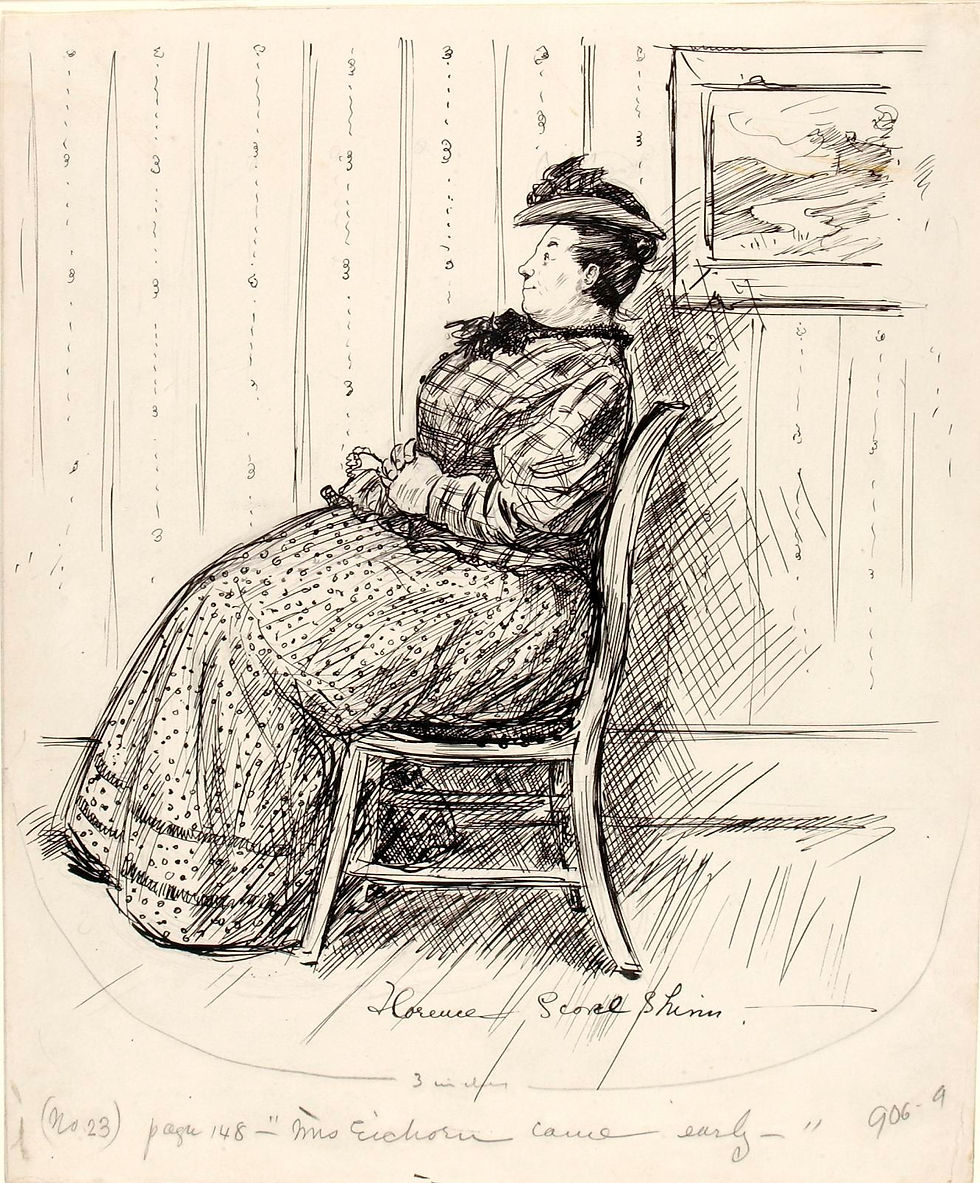
Florence Scovel Shinn entered public life through art, not self-help. Publisher biographies describe her as an artist and illustrator of children’s literature who spent years working in New York City before becoming a New Thought lecturer and writer. Library records preserve that earlier career rather than treating it as a footnote.
The Library of Congress catalog indexes multiple works under “Shinn, Florence Scovel, 1871-1940, artist,” including pen-and-ink drawings held in the Cabinet of American Illustration. The New York Public Library catalog records Winston Churchill’s 1906 novel Coniston with illustrations by Florence Scovel Shinn. Other period books also carry her illustrations.
This part of her story matters because her later writing retained an illustrator’s instinct. She thought in scenes. Walls of Jericho. Red Seas. Doors. Wands. Boomerangs. Ships. Cupboards. Umbrellas. Snow White. A woman preparing furniture for buyers while a blizzard raged outside. Her metaphysics repeatedly arrived as a picture.
That visual intelligence may be one reason the work stayed memorable. Florence could make an invisible principle feel like something a reader could see.
Source note: Library of Congress Prints & Photographs catalog; New York Public Library research catalog; Penguin Random House author biography.
The book a publisher would not take
The defining publishing decision came in 1925. Penguin Random House’s author biography states that Florence was unable to find a publisher for The Game of Life and How to Play It, so she published it herself.
That fact deserves more attention than it usually receives. The book now sits inside major publishing catalogs, appears in collectible editions, is freely available through public-domain libraries and is regularly described as a classic. But its first route into the world depended on the author deciding that rejection was not the final verdict on the work.
The original book is compact. Project Gutenberg’s edition contains ten principal chapters: The Game; The Law of Prosperity; The Power of the Word; The Law of Nonresistance; The Law of Karma and the Law of Forgiveness; Casting the Burden; Love; Intuition or Guidance; Perfect Self-Expression or the Divine Design; and Denials and Affirmations.
That table of contents is almost an executive summary of Florence’s entire philosophy. Human life has patterns. Expectation matters. Words matter. Resistance magnifies struggle. Forgiveness releases. Guidance is available. There is a form of right expression that belongs uniquely to each person. And language can be used deliberately rather than unconsciously.
She did not need 500 pages to establish the framework. She needed a game, a few laws and stories people remembered.
Source note: Penguin Random House author biography; Project Gutenberg edition no. 74878, original publication recorded as 1925.
What made Florence sound different
Florence’s writing is spiritual, biblical and unmistakably New Thought, but the tone is rarely academic. It is colloquial. She moves rapidly from scripture to a client story, from metaphysics to money, from an ancient image to a New York problem. The effect is less like reading a doctrine and more like overhearing a practical teacher who has seen the same pattern in many lives.
That tone was recognized by other New Thought figures. Editions of her work preserve an appreciation from Emmet Fox that highlights her informality, friendliness and use of everyday examples. Decades later, Louise Hay credited The Game of Life and How to Play It with helping clarify her own thinking and move her forward on her path. The lineage is visible: a woman writing in the 1920s influenced one of the women who would later become synonymous with affirmations and self-love in late twentieth-century self-help.
Florence’s language also refuses to treat spiritual work as passive. Faith, in her system, frequently requires behavior. Prepare. Speak differently. Stop rehearsing the unwanted outcome. Make room. Follow the hunch. Give thanks before the evidence arrives. Release resentment. Act as if the path is opening.
That combination - metaphysical confidence plus ordinary action - is one of the strongest reasons her work still travels.
Source note: Penguin Random House/Tarcher 2009 edition includes endorsements from Emmet Fox and Louise Hay; original works available through Project Gutenberg and public-domain archives.
The methods that made Florence Scovel Shinn timeless
Florence’s books are full of anecdotes, but underneath them is a remarkably consistent operating system. These are the methods a new reader should understand first.
1. The spoken word
This is Florence’s signature method. She treats speech as direction. What a person repeatedly says about money, love, work, health, opportunity or identity is not casual background noise in her system; it is part of the pattern that person keeps strengthening.
Your Word Is Your Wand turns the principle into an entire book. Its structure is strikingly modern: short sections organized around specific areas of life - success, prosperity, happiness, love, forgiveness, debt, interviews, guidance, protection, memory and more - followed by concise statements designed to replace habitual fear-language with a chosen expectation.
This is why Florence remains so quotable. Her method compresses. A whole philosophy can become one sentence that a person actually remembers at 2 p.m. when the old reaction appears.
2. Affirmations as deliberate language
Modern readers often encounter affirmations as inspirational captions. Florence used them more functionally. The affirmation was a replacement pattern: a consciously selected statement meant to interrupt the automatic story and direct attention toward a different expectation.
Her affirmations are often vivid rather than bland. They name the desired quality, invoke timing and direction, and frequently include phrases such as “under grace” and “in perfect ways.” The style reflects her spiritual worldview while also revealing a practical concern: the reader should not become rigidly attached to one narrow route.
That makes her affirmations less like wish lists and more like verbal orientation.
3. Expectation
One of Florence’s most persistent questions is simple: what do you expect? In The Secret Door to Success, expectation is treated as a creative posture. A person may consciously say they want one result while emotionally rehearsing another. Florence repeatedly asks the reader to notice which outcome is actually being prepared for.
This is where her famous practical stories matter. The person who expects good does not merely insist mentally that good is coming; they make room for it. They buy the dress. Clear the shelf. Prepare the furniture. Show up. Florence calls this kind of movement active faith.
4. Active faith and preparation
Florence’s faith is rarely inert. Preparation becomes evidence that the inner decision has moved into behavior. One of her recurring teaching patterns is to have someone act in harmony with the anticipated result before circumstances have fully changed.
For a contemporary reader, this is one of her most useful bridges between spirituality and self-help. The inner picture is not an excuse to avoid action. It is supposed to change action.
5. The law of nonresistance
Florence teaches that fighting mentally with an unwanted condition can keep attention bound to it. Nonresistance is not the same as passivity in her work. It is the refusal to make an obstacle the center of consciousness.
Her preferred move is redirection: stop feeding the battle, return to the desired pattern, and allow a new route to become visible. In modern language, this sits close to the idea that attention is a limited resource and that chronic fixation can become its own form of reinforcement.
6. Casting the burden
“Casting the burden” is Florence’s language for releasing the weight of a problem instead of carrying it continuously in thought. The method appears in The Game of Life as part of her discussion of impressing the subconscious.
Practically, it functions as a reset. Name the burden. Hand it over spiritually. Stop compulsively rehearsing it. Then return to the expectation of right resolution. For readers who become trapped in mental looping, this is one of her cleanest interventions.
7. Intuition and guidance
Florence gives intuition an unusually practical role. Guidance is not decorative spirituality; it is information to be acted upon. She repeatedly warns against reasoning oneself out of a strong inner signal and famously treats the “hunch” as something worthy of respect.
Her emphasis on intuition also protects the philosophy from becoming purely formulaic. The right next action may not be obvious from logic alone. The work is therefore both declarative and receptive: speak, expect, prepare - and listen.
8. The Divine Design and perfect self-expression
One of Florence’s most beautiful concepts is the Divine Design: the idea that there is a form of expression, work, relationship and contribution that fits the individual rather than forcing the individual to imitate somebody else’s path.
Perfect self-expression is not merely “getting what you want.” It is becoming available to what belongs to you specifically. This gives her prosperity teaching a deeper center. The aim is not random acquisition; it is right expression.
9. Prosperity and circulation
Florence writes openly about money. She uses examples involving bills, jobs, sales, property and unexpected financial supply. But prosperity in her framework is connected to spiritual source, expectation and circulation rather than only accumulation.
That is one reason The Game of Life has remained important in prosperity literature. Money is not pushed to the side as something unspiritual. It is treated as one area in which fear, expectation, language and action become visible.
10. Forgiveness and releasing the old pattern
Forgiveness sits inside Florence’s system because resentment ties attention to the very person or event one wants to move beyond. Her approach is practical: release the emotional claim, stop rehearsing the injury, and restore movement.
In this sense, forgiveness is not positioned as a reward for somebody else. It is part of clearing the interior field so the next chapter does not have to be built around the previous one.
SHS 2000 SYNTHESIS | Florence’s methods are compact enough to remember: speak deliberately, expect good, prepare for it, stop fighting the obstacle, release the burden, follow guidance, make room for your right expression, and refuse to let yesterday dictate the language of tomorrow.
Source note: Chapter structure from the 1925 text preserved by Project Gutenberg and Wikisource.
Her strongest works - and where to begin
The Game of Life and How to Play It - 1925
Start here. This is the architecture. It contains the main laws, the stories, Florence’s tone and the ideas that later books sharpen. It is also the work with the strongest modern proof of readership: thousands of monthly Project Gutenberg downloads, almost twenty thousand Goodreads ratings in the September 2026 snapshot, dozens of modern editions and continued publication by major houses.
Your Word Is Your Wand - 1928
Read this when you want the method in concentrated form. It is essentially an affirmation manual organized by life category. The book shows how intensely Florence believed in language as a daily practice. It is also a useful historical document for anyone tracing the lineage of modern affirmation culture.
The Secret Door to Success - around 1940-1941
Read this for expectation, guidance and the metaphor-rich mature voice. The chapter titles themselves - Bricks Without Straw, What Do You Expect?, The Fork in the Road, Crossing Your Red Sea, The Watchman at the Gate, The Way of Abundance - show Florence at her most visual.
The Power of the Spoken Word - 1944, posthumous
This collection, compiled after her death, extends the central theme that made Florence recognizable. The New York Public Library catalogs the 1944 Shinn Press edition as “teachings of Florence Scovel Shinn,” compiled by Christine Schneider. For researchers, this is an important distinction: it is part of the Florence corpus, but posthumously assembled.
Source note: Original/publication data: Penguin Random House author page; Sacred Texts archive; New York Public Library research catalog.
Proof of work: what a century of survival looks like
1925 → 2026 | More than 100 years have passed since The Game of Life first appeared.
SELF-PUBLISHED ORIGIN | Penguin Random House records that Florence published the book herself after being unable to find a publisher.
97 EDITIONS | Open Library currently indexes 97 editions of The Game of Life and How to Play It.
6,448 DOWNLOADS / 30 DAYS | Project Gutenberg’s live page showed 6,448 downloads in the previous 30 days when checked 10 September 2026.
19,842 GOODREADS RATINGS | Goodreads showed approximately 19,842 ratings and 1,719 written reviews for the principal work page in September 2026.
MAJOR MODERN PUBLISHERS | Her work appears in active catalogs from Penguin Random House/Tarcher, Wiley/Capstone, St. Martin’s, Dover and Simon & Schuster distributors.
2026 NEW EDITION | Penguin Random House released a new Spanish-language hardcover pairing The Game of Life and The Secret Door to Success on 18 August 2026.
LIBRARY PRESERVATION | The Library of Congress catalogs seven entries under Florence Scovel Shinn as an artist; NYPL catalogs both her illustrated books and posthumous spiritual work.
DOWNSTREAM INFLUENCE | Penguin Random House preserves Louise Hay’s statement that Florence’s book helped crystallize her own thinking.
PUBLIC-DOMAIN ACCESS | The Game of Life, Your Word Is Your Wand and other works circulate freely through major public-domain archives, giving new generations low-friction access.
The 2026 publication point is especially telling. A new Spanish-language hardcover arrived in August 2026 - more than a century after the first book - with Penguin Random House describing Florence’s wisdom as having inspired millions. That is not nostalgia. It is active market life.
Open Library’s 97-edition count tells the same story from another angle. Florence’s book did not remain attached to one publisher, one country or one format. It became a reusable cultural object: paperback, hardcover, ebook, audiobook, translation, omnibus, illustrated edition, modernized edition and public-domain digital text.
For SHS 2000 purposes, this is exactly what “proof of work” should mean for a legacy figure. The person is gone. The work keeps finding people.
Source note: Current data: Project Gutenberg, Goodreads, Open Library and Penguin Random House; institutional records: Library of Congress and New York Public Library. Metrics are snapshots and should be refreshed quarterly or annually.
A bridge between New Thought and modern manifestation culture
Florence did not invent New Thought, and SHS 2000 should never flatten a lineage into one personality. Her work belongs to a larger American metaphysical tradition associated with teachers and writers such as Phineas Quimby, Emma Curtis Hopkins, Charles and Myrtle Fillmore, Ernest Holmes, Emmet Fox and others. What Florence contributed was a particular voice inside that tradition.
She made the metaphysics everyday. She made prosperity discussable. She made the word into a tool. She made expectation observable. She made intuition practical. And she did it with the narrative instincts of an illustrator.
The modern manifestation field uses different language, but many recurring concepts are easy to recognize beside Florence’s work: self-talk, visualization, expectation, identity, affirmation, abundance, intuitive action, nonattachment to the “how,” and acting in harmony with the desired future.
That does not mean every contemporary teacher is directly descended from Florence. It means her books are an important primary source for understanding how old many “new” self-help ideas actually are.
The Louise Hay connection matters
One of the clearest examples of downstream influence is Louise Hay. In the Penguin Random House edition of The Game of Life and How to Play It, Hay is quoted crediting Florence’s book with helping her clarify her own thinking and move forward on her path.
That connection deserves to be documented because Louise Hay would later become one of the most influential voices in affirmations, self-love and mind-body self-help - and the founder of Hay House, itself a major institution in modern spirituality and personal development.
This is exactly the kind of lineage SHS 2000 should make visible. Readers should be able to move from Florence → Louise Hay → later affirmation and self-love culture and understand that ideas travel through people, books, publishers and generations.
Source note: Penguin Random House/Tarcher edition, ISBN 9781585427451, preserves Louise Hay’s endorsement and Florence’s publication history.
Why her self-publishing story still matters
There is a delicious symmetry in Florence’s publishing history. The book that could not initially secure a publisher is now sold by some of the largest publishing houses in the world.
Penguin Random House. Wiley. St. Martin’s. Dover. Simon & Schuster distribution. New editions, annotated editions, modernized editions, translated editions, complete works and collectible hardbacks. The work was not validated first and written second. It was written, refused, released anyway - and then validated across a century.
That is worth preserving as part of her story because self-help itself is full of people waiting for permission. Florence’s own publication history quietly contradicts that instinct.
Why Florence still feels fresh
There are legacy books people respect because they are old. Florence’s work is different: readers still use it.
Part of that is brevity. Part of it is the story structure. Part of it is the directness. But a larger reason is that she wrote about recurring human loops rather than temporary trends. Fear of not having enough. Fear of being abandoned. Fear that the opportunity has passed. Fear that another person controls the outcome. Fear of the unexpected bill. Fear of taking the leap. Fear that the inner signal cannot be trusted.
Those fears did not disappear when the century changed. Neither did the need for language that helps a person interrupt them.
Florence also understood something content creators are rediscovering now: the memorable line is not superficial when it carries a complete method. “Your word is your wand” is short enough to become a title, but large enough to organize a life practice around. “The Game of Life” is simple enough for a cover, but broad enough to hold prosperity, relationships, forgiveness, guidance and purpose.
Her genius was compression.
What a new reader should notice
If you are reading Florence for the first time, do not rush to collect every affirmation. Watch the pattern underneath them.
• Notice how often she asks the reader to change expectation before circumstances change.
• Notice how often she pairs faith with preparation or action.
• Notice how frequently she redirects attention away from the obstacle and toward the desired state.
• Notice the distinction between forcing a specific route and trusting a “right” route.
• Notice how intuition is treated as practical guidance, not decoration.
• Notice how many current self-help concepts are already present in older language.
Then read slowly enough to test which ideas actually become useful in your own daily vocabulary. Florence was never a teacher of passive admiration. Her books are written to be used.
Florence Scovel Shinn is not simply an early manifestation writer. That label is too small.
She is a bridge figure: artist to teacher, New Thought to mainstream self-help, biblical metaphor to practical affirmation, private spiritual practice to everyday language. Her work helped make it normal for ordinary people to examine the relationship between their words, expectations and experience.
Her first book survived because it is easy to enter and difficult to exhaust. A reader can finish it quickly, then discover on a second reading that the real material is not the anecdotes - it is the attention being trained beneath them.
For a project built to document the teachers who shaped how people heal, grow, think and transform, Florence is foundational.
The Self Help Show Salute
Florence Scovel Shinn, we give you your flowers. For the book you released when a publisher would not. For making spiritual law sound like something a person could actually use on an ordinary Tuesday. For giving generations a language of expectation, guidance, prosperity and right self-expression. For reminding readers that words deserve stewardship. And for leaving behind work strong enough to keep being discovered more than a century after you first put it into the world. The illustrator became the teacher - and the pictures never left the teaching. Doors still open. Red Seas still part. Wands still point. And readers are still learning how to play the game. Thank you for what you left behind.
Frequently asked questions about Florence Scovel Shinn
Who was Florence Scovel Shinn?
Florence Scovel Shinn (1871-1940) was an American artist, illustrator, New Thought lecturer and spiritual writer best known for The Game of Life and How to Play It, which she self-published in 1925 after being unable to secure a conventional publisher.
What is Florence Scovel Shinn best known for?
She is best known for teaching the power of the spoken word, affirmations, expectation, nonresistance, prosperity, intuition and the idea of a “Divine Design” or right form of self-expression.
What should I read first?
Begin with The Game of Life and How to Play It. It contains the full framework in its most accessible form. Then move to Your Word Is Your Wand for concentrated affirmation practice and The Secret Door to Success for expectation, guidance and mature teaching stories.
Did Florence Scovel Shinn self-publish her first book?
Yes. Penguin Random House’s author biography states that she was unable to find a publisher, so she published The Game of Life and How to Play It herself in 1925.
Is Florence Scovel Shinn still widely read?
Yes. In September 2026, Project Gutenberg recorded thousands of downloads in a single 30-day period, Goodreads showed nearly 20,000 ratings for The Game of Life, Open Library indexed 97 editions, and major publishers continued to issue new editions and translations.
Did Florence influence Louise Hay?
Yes. Penguin Random House preserves an endorsement in which Louise Hay credits The Game of Life and How to Play It with helping clarify her own thinking and move her forward on her path.


