Louise Hay: Giving Flowers to the Woman Who Made Self-Love a Global Practice

A Self Help Flowers honorary profile on the author, teacher and publisher whose affirmations, mirror work, AIDS support gatherings and publishing vision helped shape modern self-help culture.
SELF HELP FLOWERS • SELF-LOVE • AFFIRMATIONS • HEALING • PUBLISHING • SPIRITUALITY
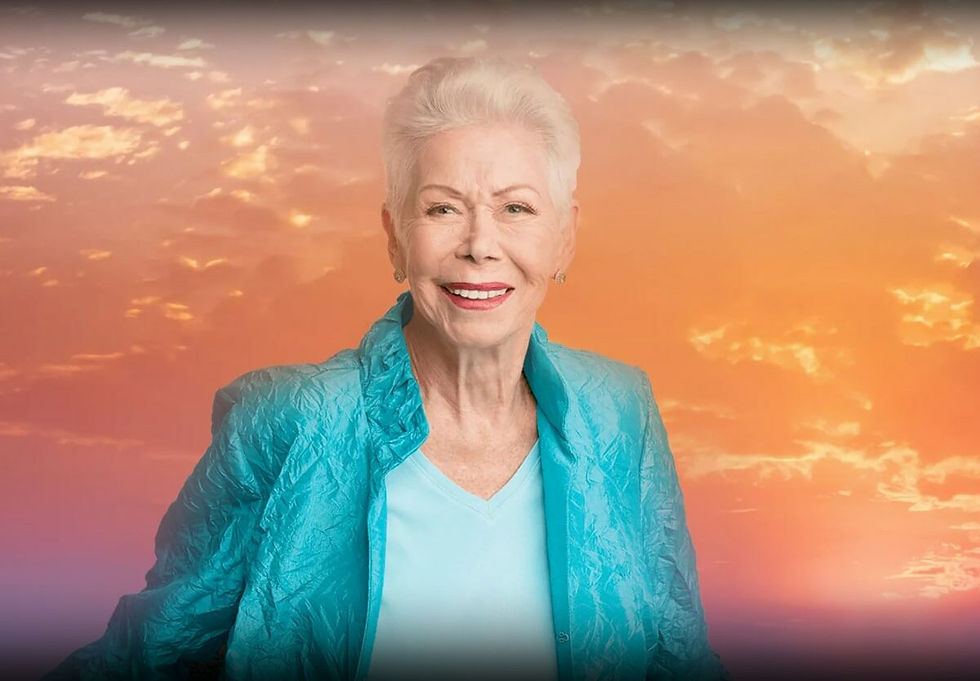
By The Self Help Show Editorial Team • Self Help Flowers Profile • Last reviewed: 21 September 2026
Louise Hay helped make self-love practical. Not abstract, not ornamental, not something reserved for a perfect day. She taught people to stand in front of a mirror and speak differently to themselves. She taught that inner language matters, that repetition matters, that the tone of one's relationship with oneself can become a daily practice rather than a theory.
Her reach became enormous. Penguin Random House and Hay House report that You Can Heal Your Life has sold more than 50 million copies worldwide. Her official Louise Hay biography records more than 30 books, decades of audio and video teachings, appearances on The Oprah Winfrey Show and a publishing company that grew from a small home-based operation into one of the most recognizable names in mind-body-spirit publishing.
Louise Hay (1926-2017) was an American self-help author, teacher and publisher best known for You Can Heal Your Life, which has sold more than 50 million copies worldwide. She popularized affirmation practice and mirror work, founded Hay House, and began the Hayride AIDS support gatherings in Los Angeles in 1985. Her work centers on self-love, forgiveness, thought patterns, receiving and deliberately changing inner dialogue.
But the scale alone does not explain why Louise belongs in Self Help Flowers. Her story joins personal reinvention, publishing, community care and a remarkably consistent message: the inner voice can become kinder, the past does not need to become permanent identity, and self-acceptance can be practiced deliberately.
Her work also crossed from private practice into institution building. In the mid-1980s, during the AIDS crisis, she began support meetings that grew from six men in her living room to hundreds of weekly attendees. She founded the Hay Foundation. She created Hay House. Then Hay House became a home for other transformational writers and teachers, extending her influence through voices far beyond her own.
This profile gives flowers to the full arc. It follows the girl born in Los Angeles in 1926, the young woman who left home, the New York fashion model, the student of Religious Science, the author who self-published her early work, the teacher whose mirror practice traveled around the world, the woman who opened her home during a devastating public-health crisis, and the publisher whose company continues to shape the field nearly a decade after her death.

Louise Hay at a glance
Louise Hay at a glance | |
Field | Record |
Full name | Louise Lynn Hay |
Born | 8 October 1926, Los Angeles, California, United States |
Died | 30 August 2017, San Diego, California, United States |
Primary fields | Self-help, New Thought, affirmations, self-love, mind-body spirituality, publishing |
Early breakthrough | Heal Your Body, first published in the 1970s |
Landmark book | You Can Heal Your Life, 1984 |
Documented reach | 50M+ copies of You Can Heal Your Life sold worldwide |
Books | 30+ books for adults and children, according to Hay House |
Signature practices | Affirmations, mirror work, self-love, forgiveness, changing habitual thought, gratitude, receiving |
Community work | The Hayride AIDS support gatherings, founded in 1985 |
Institution founded | Hay House, founded in 1984 and incorporated in 1987 |
Philanthropy | The Hay Foundation, established in the 1980s |
Centennial year | 2026 marks 100 years since her birth |
Verification note: Core biography, timeline, publishing history and sales figures are drawn primarily from the Louise Hay biography, Hay House and Penguin Random House. Historical reporting on the Hayride is cross-checked against the Los Angeles Times.
Why Louise Hay belongs in Self Help Flowers
Louise Hay belongs here because she changed the vocabulary of self-help. Today, phrases such as self-love, affirmations, inner dialogue, limiting beliefs and mirror work are familiar across wellness culture. Louise was teaching versions of these ideas decades before they became everyday social-media language.
Her distinctive contribution was not simply telling people to think positively. She created repeatable rituals. Speak an affirmation. Write a new thought. Look into your own eyes in the mirror. Practice praise instead of criticism. Notice the belief underneath a recurring pattern. Choose a new sentence. Return to it again tomorrow. The work was small enough to perform in a bathroom mirror and large enough to become a philosophy of life.
She also built infrastructure. A teacher can influence through ideas. A publisher can shape what ideas reach the public. Louise eventually did both. Hay House gave platforms to writers including Wayne Dyer and many other transformational authors, meaning her legacy became partly editorial: she helped decide which voices would enter millions of homes.
1926 to the early 1970s: a life that kept changing form
Louise Hay was born in Los Angeles on 8 October 1926. Her official Louise Hay biography describes an unstable, impoverished childhood and difficult teenage years. She left home young and later made her way to New York City, where she built a career as a fashion model. Her official timeline records work for designers including Bill Blass and a marriage to businessman Andrew Hay that lasted fourteen years.
The polished surface of the modeling years sat beside a deeper search that intensified after the marriage ended. In the early 1970s, Louise began studying at the Church of Religious Science in New York. A later profile published by Science of Mind recalled her describing the moment she heard the proposition that changing one's thinking could change one's life. She became an avid student.
That pivot matters because Louise did not enter self-help as a conventional academic. She entered through lived reinvention, spiritual study and counseling. The language she later used with readers remained intimate for that reason. It often sounded less like instruction from a podium and more like someone sitting beside you saying, try this sentence instead.

From spiritual study to Heal Your Body
By the 1970s Louise was counseling and teaching within the Religious Science tradition. Her early work became Heal Your Body, sometimes remembered as the little blue book. The format was simple and highly portable: physical conditions were paired with what Louise described as possible mental or emotional patterns, followed by new affirmations intended to support a different inner orientation.
The concept became one of the most recognizable features of her work. It also established a template she would use repeatedly: identify the habitual thought, choose a different thought, repeat it until the new language becomes more familiar than the old one.
Her official Louise Hay site says Heal Your Body eventually reached readers in 33 countries and was translated into 25 languages. Hay House and Penguin Random House continue to publish the title, making it one of the clearest examples of a compact legacy text that has remained commercially and culturally active for decades.
Louise Hay's cancer story and the philosophy it intensified
Louise later wrote and spoke about receiving a cancer diagnosis in the late 1970s. In her own account, she responded by combining medical consultation with intensive inner work, nutritional changes, forgiveness, emotional release and the mental practices she had been teaching. Her official Louise Hay biography presents this period as one of the defining experiences behind her philosophy.
Whatever part of her audience first encountered her through that story, the more durable teaching was broader than illness. Louise repeatedly returned to the idea that resentment, criticism, fear and self-rejection keep a person in an inner environment that can be changed. Her preferred starting point was not punishment. It was love.
That emphasis is why self-love became the center of her system rather than a side topic. For Louise, loving oneself was not indulgence. It was a practical change in the quality of the inner conversation from which choices, boundaries, expectations and daily behavior emerge.
1984: You Can Heal Your Life
In 1984 Louise published You Can Heal Your Life, the book that would carry her work into global culture. Penguin Random House now describes it as an international sensation and New York Times bestseller with more than 50 million copies sold worldwide.
The book expanded the compact framework of Heal Your Body into a larger philosophy of self-relationship. It addressed thought patterns, childhood conditioning, forgiveness, prosperity, relationships, work, the body and the possibility of choosing new beliefs. Louise wrote in a direct style that made large metaphysical claims feel domestic. The work could happen while getting dressed, driving to work, speaking to a partner, looking in a mirror or noticing one harsh sentence in the mind.
Its continued publishing life is remarkable. A 40th anniversary edition appeared in 2024. Hay House and Penguin Random House scheduled a deluxe keepsake edition for 6 October 2026, two days before what would have been Louise's 100th birthday. A book born in 1984 is therefore still being materially redesigned, republished and marketed to new readers more than four decades later.

The core method: affirmations as everyday mental language
Affirmations are the method most closely associated with Louise Hay. Her definition was broader than a list of inspirational sentences. On her official Louise Hay site, she described all self-talk as a stream of affirmations. In that sense, the mind is already practicing something. The question is what it is practicing.
The practical move is to hear the habitual statement and replace it intentionally. If the old sentence is built around inadequacy, danger, criticism or scarcity, the new affirmation is designed to rehearse safety, worth, possibility, love or trust instead.
Louise's strength was repetition without embarrassment. She did not treat repeating a kind statement to oneself as childish. She treated repetition as training. The new sentence might feel unfamiliar precisely because the old sentence has had years of rehearsal.
Mirror work: turning self-love into something you physically practice
Mirror work may be Louise Hay's most distinctive ritual. She taught people to look directly into their own eyes and speak affirmations aloud. Her official mirror-work explanation calls it her most effective method for learning to love oneself and experience the world as safer and more loving.
The mirror adds confrontation. A sentence that is easy to write in a notebook can feel completely different when spoken while maintaining eye contact with oneself. Louise used that discomfort as information. If saying “I love you” to your own reflection produces resistance, then the resistance becomes the place to work.
The practice eventually became formalized in Mirror Work: 21 Days to Heal Your Life. The structure is important. Louise did not frame self-love as one breakthrough moment. She framed it as repeated exposure to a new relationship with the self.
A Louise Hay mirror-work pathway
A Louise Hay mirror-work pathway | |
Stage | Practice |
1. Arrive | Stand at the mirror and notice the immediate emotional reaction without leaving. |
2. Eye contact | Look directly into your own eyes rather than treating the mirror as cosmetic inspection. |
3. Speak kindly | Use a short affirmation of love, acceptance, safety or willingness. |
4. Notice resistance | Pay attention to embarrassment, criticism, grief or disbelief that surfaces. |
5. Repeat | Return daily so the relationship changes through familiarity. |
6. Expand | Apply affirmations to work, relationships, receiving, health, money and purpose. |
Self-love as the foundation rather than the reward
Louise repeatedly reversed a common bargain people make with themselves: I will love myself after I improve. Her teaching was to begin with love now. The improved choices are then allowed to grow from a less hostile inner environment.
Her official FAQ puts this in direct behavioral terms: reduce criticism, practice praise, look into the mirror, speak love aloud and accept yourself as you are. The method is almost disarmingly simple. Its significance lies in how many areas of life it can touch once the self is no longer treated as the enemy.
This is also why her work has remained so portable across generations. The cultural language around mental wellness changes. The underlying human problem of hostile self-talk does not disappear. Louise created practices that remain understandable even when the surrounding vocabulary shifts.
Forgiveness and releasing the past
Forgiveness runs through Louise's books, recordings and workshops. She taught that releasing resentment is less about declaring the past acceptable and more about refusing to keep carrying the same emotional relationship to it.
Her own story made this theme central. Her official Louise Hay biography describes a difficult childhood and later personal upheavals. Instead of building an identity around those events, her public teaching emphasized the possibility of choosing what the inner voice repeats now.
Within her framework, forgiveness, self-love and affirmations are not separate topics. They work together. Forgiveness creates space. Self-love changes the quality of the relationship with oneself. Affirmations give the mind new language to inhabit that space.
Prosperity, receiving and the permission to expect good
Louise also wrote extensively about prosperity. Her language was not limited to money. Prosperity included supportive work, loving relationships, opportunity, creativity, health, time, joy and the ability to receive.
A recurring theme was willingness. People can say they want a new life while continuing to rehearse sentences that make receiving feel dangerous, undeserved or impossible. Louise encouraged people to notice those contradictions and practice a more receptive internal posture.
This makes her work relevant to modern discussions about self-concept. Before the term became central in manifestation communities, Louise was already asking readers to examine the identity statements they repeat and the emotional permission they give themselves to receive good.
1985: the Hayride and a radical form of showing up
One of the most important chapters in Louise Hay's life happened outside the bestseller lists. In 1985, during the AIDS crisis, she began a support group in Los Angeles with six men diagnosed with AIDS. The meetings became known as the Hayride.
By 1988, Hay House and Louise's official Louise Hay biography say the weekly gathering had grown to around 800 people and moved to an auditorium in West Hollywood. Contemporary Los Angeles Times reporting from March 1988 described gatherings drawing roughly 600 to 700 participants each week, including people with AIDS, friends, partners and family members.
The historical context matters. Fear, stigma and isolation around AIDS were immense. Louise created a space organized around welcome, meditation, conversation, touch, community and hope. Her approach reflected her metaphysical worldview, but the record of the gathering also shows something simpler and concrete: people came because there was a place where they could gather without being treated as untouchable.
Self Help Flowers should record this because proof of work is not only sales. It is also where a teacher chose to stand when people were afraid to stand beside one another.
Hay House: from one woman's books to an entire publishing ecosystem
Louise founded Hay House in 1984 and incorporated the company in 1987. The company's own history says it began as a way for her to publish transformational books and audio programs, first her own and then the work of other authors.
That decision radically expanded the shape of her legacy. Hay House became one of the most influential publishing brands in the mind-body-spirit field. Its current company materials describe international operations and customers in more than 35 countries.
For the Self Help Flowers encyclopedia, this is a major proof point because Louise did not simply build an audience. She built a distribution system for a category. Writers and teachers who might once have struggled to find conventional publishing support gained a specialist platform with readers already interested in transformation, spirituality and personal growth.
The company also created conferences, audio programs, card decks, online learning, radio programming and other formats. Louise's influence therefore moved from author to media founder. Her publishing decisions helped shape the canon that later generations inherited.
The Hay Foundation: turning the philosophy into giving
Louise also established the Hay Foundation, a nonprofit created to support organizations serving people, animals and the environment. Her official Louise Hay site describes grants and support for needs including food, shelter, counseling, hospice care, AIDS-related services and assistance for women in crisis.
This part of the record is important because the language of abundance can become empty if it never reaches anyone else. Louise's philanthropic work gives the philosophy a material dimension: resources moving outward into care.
The Power Is Within You
Published in the early 1990s, The Power Is Within You extended the themes of You Can Heal Your Life into a more explicit invitation to reclaim agency. The title captures Louise's core orientation. She did not want readers permanently dependent on a teacher. She wanted them practicing a different relationship with their own mind, body and inner guidance.
The book developed themes of listening inwardly, releasing fear, using affirmations, loving the self, forgiving, receiving and choosing thoughts that support the life one wants to inhabit.
I Can Do It, Empowering Women and everyday repetition
Louise's later catalog became a large ecosystem of books, workbooks, recordings, card decks, journals and calendars. I Can Do It distilled her approach into compact affirmation practice. Empowering Women focused directly on self-worth, self-esteem, autonomy and the social conditioning women carry.
This multiplication of formats was strategic even if it did not look like strategy. A reader did not need to sit with a 300-page book every morning. Louise's language could appear on a card beside the bed, in a calendar, through an audio track in the car, in a workbook, at a live event or through a mirror practice in the bathroom. The message was distributed into ordinary life.
Life Loves You and the mature Louise Hay message
The phrase captures the emotional atmosphere of her mature teaching. Instead of approaching life as an adversary that must be forced into submission, she encouraged a relationship based on trust, receptivity and participation.
A selected reading path through Louise Hay
A selected reading path through Louise Hay | |
Title | Why it matters |
Heal Your Body | The compact early framework linking thought patterns with new affirmations. |
You Can Heal Your Life | The central Louise Hay text and the best single introduction to her worldview. |
The Power Is Within You | A deeper exploration of agency, self-love and inner guidance. |
Love Yourself, Heal Your Life Workbook | A practical workbook for applying the ideas rather than only reading them. |
Empowering Women | Louise's self-worth and empowerment work directed specifically toward women. |
I Can Do It | A compact entry point into affirmation practice. |
You Can Create an Exceptional Life | A conversational work with Cheryl Richardson on living the teachings day by day. |
Life Loves You | A late-career collaboration with Robert Holden centered on trust, forgiveness, receiving and love. |
Mirror Work: 21 Days to Heal Your Life | The clearest structured guide to her signature mirror practice. |
Proof of work
Louise Hay proof points | |
Proof point | Documented record |
You Can Heal Your Life | 50M+ copies sold worldwide, according to Penguin Random House and Hay House |
Author catalog | 30+ books for adults and children |
Global book reach | Penguin Random House has described Louise as having more than 60M books sold worldwide across her catalog |
Heal Your Body | Official biography says the title reached 33 countries and 25 languages |
Hayride | Began with 6 men in 1985; grew to roughly 800 weekly participants by 1988 in official records |
Hay House | Founded in 1984 and incorporated in 1987; grew into a major mind-body-spirit publisher |
Current Hay House reach | Company materials describe customers in more than 35 countries |
Media | Appearances included The Oprah Winfrey Show plus extensive radio, television, audio and video teaching |
Longevity | You Can Heal Your Life received a 40th anniversary edition in 2024 and a centennial keepsake edition scheduled for October 2026 |
Legacy products | New calendars, audio programs, journals, cards and editions continue to be released after her death |
Why her proof of work is bigger than follower counts
Louise died in 2017, so contemporary social follower counts are not the right primary measure of her legacy. Her strongest evidence is transmission across time. Books stay in print. New editions keep appearing. Her signature practice still has a recognizable name. The publishing house she founded remains active. New authors continue to enter the market through the infrastructure she helped create.
The deeper metric is linguistic. “Mirror work” is understood as a practice. Affirmation decks are a mainstream product category. Self-love is central vocabulary in modern wellness. Louise did not invent every idea associated with those terms, but she became one of the most important popularizers who made them practical and repeatable for a mass audience.
2026: Louise Hay at 100
Louise Hay would have turned 100 on 8 October 2026. The centennial offers an unusually strong editorial moment for this Self Help Flowers profile.
Hay House continues to publish new Louise Hay material. A deluxe keepsake edition of You Can Heal Your Life is scheduled for 6 October 2026, two days before her centenary, with bonus Mirror Work material and commemorative design elements. The publisher also released the 2027 edition of the I Can Do It calendar in July 2026.
A century after her birth, the work is not sitting behind glass. It is still being repackaged for new readers. That is one of the clearest possible measures of cultural durability.
Louise Hay's method map
Louise Hay's method map | |
Method | Core idea |
Affirmations | Change the repeated language that shapes expectation and identity. |
Mirror work | Practice self-love while looking directly into your own eyes. |
Self-love | Stop postponing acceptance until after improvement. |
Forgiveness | Release the ongoing emotional claim of the past. |
Thought awareness | Notice inherited and habitual beliefs instead of treating them as truth. |
Praise over criticism | Train the inner voice to support rather than attack. |
Receiving | Become willing to allow love, prosperity, help and opportunity. |
Gratitude | Direct attention toward what is already supportive and alive. |
Repetition | Return to the new thought until it becomes familiar. |
Community care | Extend the philosophy beyond the self through support, publishing and giving. |
The lineage: where Louise sits in the larger Self Help Flowers map
Entity | Relationship to Louise Hay |
You Can Heal Your Life | Landmark 1984 book; 50M+ reported global sales |
Heal Your Body | Early foundational book and compact mind-body affirmation framework |
Mirror Work | Signature 21-day self-love practice |
Hay House | Publishing company founded by Louise Hay |
Hay Foundation | Philanthropic organization founded by Louise |
Hayride | AIDS support gatherings begun by Louise in 1985 |
Religious Science / Science of Mind | Spiritual tradition in which Louise studied and ministered |
Wayne Dyer | Major Hay House author and Self Help Flowers Profile #010 |
Robert Holden | Co-author of Life Loves You |
Cheryl Richardson | Co-author of You Can Create an Exceptional Life |
Florence Scovel Shinn | Earlier New Thought lineage connection; Self Help Flowers Profile #006 |
Ernest Holmes | Religious Science founder and key lineage connection |
Louise Hay belongs to a lineage that includes New Thought, Religious Science and the long tradition of writers who treated thought, belief and spiritual identity as forces in human life. Self Help Flowers should connect her profile to Ernest Holmes, Florence Scovel Shinn, Joseph Murphy, Emmet Fox and other earlier voices.
The downstream map is just as important. Through Hay House, Louise became directly connected to major modern teachers including Wayne Dyer and many later authors in spirituality, health and personal transformation. Her profile is therefore both an individual biography and a hub inside the wider encyclopedia.
Frequently asked questions
Who was Louise Hay?
Louise Hay was an American self-help author, teacher and publisher known for affirmations, mirror work and the international bestseller You Can Heal Your Life. She also founded Hay House, which became a major publisher in the mind-body-spirit field.
What is Louise Hay best known for?
She is best known for You Can Heal Your Life, her use of positive affirmations, and mirror work, a practice of looking into one's own eyes while speaking supportive statements aloud.
How many copies did You Can Heal Your Life sell?
Penguin Random House and Hay House report more than 50 million copies sold worldwide.
What is mirror work?
Mirror work is Louise Hay's signature practice of looking directly at oneself in a mirror and speaking affirmations aloud, especially statements of love, acceptance, safety and willingness.
Did Louise Hay found Hay House?
Yes. Louise founded Hay House in 1984 and incorporated the company in 1987. It grew from a small home-based publishing venture into an international mind-body-spirit publishing company.
What was the Hayride?
The Hayride was an AIDS support gathering Louise began in Los Angeles in 1985 with six men. By 1988, official accounts say the weekly meetings had grown to around 800 people.
What books should a beginner read first?
A strong starting sequence is You Can Heal Your Life, The Power Is Within You and Mirror Work: 21 Days to Heal Your Life.
When was Louise Hay born?
She was born on 8 October 1926 in Los Angeles. The year 2026 marks the centennial of her birth.
The Self Help Flowers Salute
Louise Hay, these flowers are for the woman who kept returning people to the simplest relationship they carry everywhere: the relationship with themselves.
They are for the mirror. For the sentence repeated until it stopped sounding impossible. For the reader who opened a book in a difficult season and found language that felt gentler than the voice already living in their head.
They are also for the builder. You did not stop at writing your own books. You opened your home. You gathered people during a frightening epidemic. You created a foundation. You created a publishing house. Then that house became a door through which many other teachers walked.
A hundred years after your birth, new readers are still meeting the work. New editions are still appearing. The company is still publishing. The practice still has a name.
Self Help Flowers gives Louise Hay her flowers for helping generations practice the possibility that the voice inside can become a place of love.


